September 23, 2012

Zero tolerance


By SUHRID SANKAR CHATTOPADHYAY

FRONTLINE, Volume 29 - Issue 17:: Aug. 25-Sep. 07, 2012

Chief Minister Mamata Banerjee’s absolute intolerance of criticism resurfaces with the arrest of a farmer.


Mamata Banerjee. Her apparent paranoia has made her overdependent on the police.

West Bengal Chief Minister Mamata Banerjee has made it very clear that she will not tolerate dissent, criticism and jokes against her government and that police action will be initiated against her critics. First came the arrest of a professor who forwarded an innocuous cartoon of her by e-mail; then came the branding of a college student who asked her an uncomfortable question on a private television channel’s chat show as a Maoist; and now an indigent farmer has been detained for voicing his grievances to the Chief Minister at a public meeting.

All Shiladitya Chowdhury, a farmer from Binpur, did was to point out to Mamata Banerjee at a rally at Belpahari in Pashchim Medinipur district that the rise in fertilizer prices was ruining farmers. But that was enough for the angry Chief Minister to label him a “Maoist” and have him arrested under non-bailable sections of the Indian Penal Code (IPC).

On August 8, like thousands of others in the region, Shiladitya had gone to attend Mamata Banerjee’s rally at Belpahari. The area was until recently a known Maoist belt, and so the Chief Minister’s rally was taking place amid heavy security. Shiladitya, who was sitting in the front row beyond the security cordon, got up in between and loudly said that farmers were dying and were not getting proper prices for their produce, that fertilizer prices were increasing, and that the government was not doing enough to redress farmers’ grievances.

Mamata Banerjee reacted aggressively, pointing him out in the crowd and ordering the police to catch him. As he was being led away, she referred to him as a Maoist who had sneaked into the rally ground to create disturbance. Upon questioning Shiladitya, the police found that he had no links with the banned Communist Party of India (Maoist) and allowed him to return home. But later, the Jhargram Superintendent of Police, Bharati Ghosh, reportedly claimed that Shiladitya had “escaped” before the interrogation was completed – a feat that is difficult if not impossible given the heavy security at the venue.

After his “escape”, Shiladitya went straight home to Nayagram, but the police waited two whole days before picking him up again on the night of August 10. This time he was arrested under Sections 332 (voluntarily causing hurt to deter public servant from his duty, a non-bailable offence), 353 (assault or use of criminal force to deter public servant from discharge of his duty, non-bailable), 447 (criminal trespass, bailable) and 506 (criminal intimidation, bailable). The following morning he was produced before a district court and remanded in judicial custody for 14 days.

The arrest raised a storm of protest from a cross section of the media and civil society. Political parties, both allies of the Trinamool Congress and those in the opposition, spoke out in one voice against the arrest. Communist Party of India (Marxist) Member of Parliament Nilotpal Basu said the arrest was tantamount to “autocracy” while West Bengal Pradesh Congress Committee general secretary Om Prakash Mishra called it a “bizarre case of heightened intolerance”.
Ambikesh Mahapatra, the Jadavpur University professor who was arrested in the cartoon case. The West Bengal Human Rights Commission has recommended that the State government compensate him.

The strongest criticism came from an unexpected source – Chairman of the Press Council of India and former Supreme Court judge Markandey Katju, who had, months earlier, showered praise on Mamata Banerjee for her integrity and uprightness. “Her action is most undemocratic, to say the least. I had earlier given a statement in favour of Mamata Banerjee…. But now I have changed my opinion and believe she is totally undeserving to be a political leader in a democratic country like India…,” he reportedly said. He also warned officials carrying out her orders that they could face a situation similar to those sentenced in the Nuremberg trials.

Even in her days in the opposition when she was heading the violent agitation in Singur that led to the departure of Tata Motors’ small car project from the State, she reacted angrily to any question she perceived to be critical of her movement. The term “Tata’s agent” was attributed to anyone asking her an uncomfortable question. But after assuming charge as the Chief Minister of West Bengal in 2011, her threshold for tolerance of any perceived criticism has been diminishing at an alarming rate.

Apart from Ambikesh Mahapatra, a Jadavpur University professor of chemistry, Subrata Sengupta, septuagenarian retired engineer, was arrested for forwarding by e-mail a month-old cartoon relating to Mamata Banerjee’s insistence on removing the then Union Railway Minister, Dinesh Trivedi, from the Cabinet and replacing him with present Railway Minister, Mukul Roy. Her branding of young students who asked her uncomfortable questions on a television chat show as “Maoists” came a month later. As she stormed off the set, she asked the police to take photographs of those who had posed difficult questions to her.

There are many who feel that Mamata Banerjee appears to be constantly looking over her shoulder for unseen enemies. This apparent paranoia, say others, perhaps explains her overdependence on the police. “Apart from the intolerance and undue haste that characterises the present government so far, there appears to be a more-than-necessary dependence on the police. This may be harmful in the long run for any democratic polity,” a senior government official told Frontline. Despite all the criticism, the Mamata Banerjee government has remained unapologetic. On each occasion she and her party leaders defiantly justify their stance, no matter how illogical their justifications may appear.

In the cartoon case, the government and the party’s interpretations of the innocuous mail ranged from being “lewd and obscene” to indicating a sinister plot to kill Mamata Banerjee. The farmer’s voicing of his grievances was interpreted as a dangerous bid to breach security and cause mayhem. Mukul Roy, who was present at that meeting, claimed that Shiladitya was drunk and pushed the police personnel and women around him, although video recordings of the incident show no evidence of such action. Shiladitya, who hails from a family of policemen, had been selected for a training programme at the Central Reserve Police Force camp at Binpur.

As with the previous incidents, this time, too, the Trinamool leaders’ excuses serve only to diminish the credibility of the ruling party. “It is not what he said but how he said it that was offensive,” a Trinamool Congress source told Frontline.

HRC Report

In a development that has caused much embarrassment to the State government, the West Bengal Human Rights Commission’s report on the cartoon incident has recommended that the State government compensate both Mahapatra and Sengupta by paying them Rs.50,000 each for the manner in which they were arrested and detained and take action against the policemen responsible for the arrest. The report states: “Citizens who are expressing or airing a critical opinion about the ruling party cannot be picked up from their residence by the police at the instance of an agitated mob whose members are unhappy with the critical views of those two persons. If this is allowed to continue, then not only the human rights of the dissenters will perish but free speech, which is the life blood of our democracy, will be gagged. Constitutional provisions will be reduced to parchment promises and we will be heading towards a totalitarian regime in complete negation of democratic values….” The Commission also made it clear that “no one can attribute even remotely any suggestion which is lewd or indecent and slang” in respect of the cartoon that was forwarded.

Though it is not binding upon the State government to follow the recommendations, according to political analysts, governments normally abide by such suggestions. What remains to be seen is whether the present report will prompt the Mamata Banerjee government to avoid such embarrassments in the future.


Reign of intolerance

By SUHRID SANKAR CHATTOPADHYAY

FRONTLINE, Volume 29 - Issue 09 :: May. 05-18, 2012

Mamata Banerjee's eleven months in power in West Bengal have been marked by actions that undermine democracy.

PEOPLE wonder if this is the "poriborton", or change, she promised.

IN West Bengal, Didi, or Big Sister, is watching you. As such, one should be extra careful about what one says in public or in private and be doubly cautious about forwarding or sharing jokes through e-mail or on social media.

Ambikesh Mahapatra, a professor of chemistry at Jadavpur University, learnt this the hard way by spending 16 hours in police custody. He forwarded an innocuous joke on Chief Minister Mamata Banerjee, affectionately known as Didi, though e-mail. Mahapatra's travails have taught the people of West Bengal a valuable lesson: if they wish to stay out of trouble, they better laugh at only what Didi and her government say is funny. It would also serve the people of West Bengal better to read only those newspapers Didi and her government choose for them; watch only those television channels that Didi approves of; and, most importantly, believe only what Didi and her government tell them, for all else are lies and conspiracies.

When Mamata Banerjee promised poriborton (change in Bengali) in the State and tied up with the Congress and toppled the 34-year-old Communist Party of India (Marxist)-led Left Front government in the Assembly elections in 2011, many people perhaps did not understand what she fully meant. But in less than a year's time, most of the confusion they may have had about the kind of poriborton they were promised has certainly cleared. After all, in just 10 months Mamata Banerjee herself claimed that 90 per cent of the work she had set out to do had been finished and that she had completed 10 years' work in 10 months.

On top of the many promises and assurances that she made in the run-up to the Assembly elections was “restoring democracy”. However, less than a year later, it has turned out to be a change of a different flavour – one that people are finding a little unpalatable. From forbidding government-funded libraries to subscribe to major national and regional newspapers to detaining human rights activists, the State government has been displaying signs of an attitude not quite compatible with democratic norms. But it is the arrest of the professor that has brought to the fore the darkest and most sinister nature of the intimidation of civil society, which even the most dedicated Trinamool Congress supporters in the urban middle class have found difficult to approve of.

On April 12, Ambikesh Mahapatra was arrested by the police for forwarding a cartoon strip relating to the Chief Minister's insistence on removing Trinamool leader and Union Railway Minister Dinesh Trivedi from the Cabinet and replacing him with Mukul Roy, another Trinamool Member of Parliament. The joke was a spoof on Satyajit Ray's famous film Sonar Kella (Golden Fortress) and lifted certain dialogues from the film and applied them to the recent political developments surrounding the Railway Ministry. The cartoon was forwarded from the official e-mail id of the housing society where Mahapatra stays.

Around 12-40 a.m., the police arrested Mahapatra and Subrata Sengupta, the septuagenarian secretary of the housing society and a retired engineer of the Public Works Department, on charges of outraging the modesty of a woman, defamation and hacking (using the Internet to spread defamatory messages). Before being handed over to the police, Mahapatra was allegedly beaten up by suspected Trinamool workers who, the professor claimed, forced him to sign a statement that he was a supporter of the CPI(M). While he was kept in police custody for 16 hours before being produced in court, four of his assailants, including a local Trinamool leader, who were later arrested, were released on bail after two and a half hours.

Speaking to the media after his release, Mahapatra said, “I do not regret forwarding the mail. It was done in good humour only.” The real reason for the whole incident, it became clear later, was rivalry between Mahapatra and a group of Trinamool Congress-backed building material suppliers who had apparently been trying to seize control of the board of directors of the housing society.

Even as cries of alarm arose from sections of Mamata Banerjee's most ardent middle-class supporters at this brazen display of intolerance, the Chief Minister and her government remained unapologetic. Mamata Banerjee, who was touring the districts at the time, went into her usual defensive mode. As has become her wont, she hinted at a conspiracy by the CPI(M) and sections of the media, her latest bete noire.

“If someone commits some mischief, what will the police do? Will they not arrest him? And then the CPI(M)'s two news channels and some of the newspapers will start a slander campaign against us,” she said at a function in Durgapur. Back in Kolkata, some of her Ministers defended the arrest, even as academics, intellectuals and ordinary citizens took to the streets in protest. Many of them had attended rallies and public meetings of Mamata Banerjee. She was grateful for their support then, today she does not seem to care for their opinion. “It is only the white-collar urban people who are protesting,” a senior Trinamool leader told Frontline, insisting that the e-mail was demeaning though he could not explain how. It appears nobody can explain, without stretching the bounds of credibility, how the joke can be construed as offensive. The eminent academic Sukanta Chaudhuri of Jadavpur University said, “If this could lead to such consequences, then who is safe? Any normal activity that we carry out might bring retribution, or be a pretext for retribution, as the actual cause seems to lie in the affairs of his [Mahapatra's] housing society.”

Leader of the Opposition and CPI(M) Polit Bureau member Surya Kanta Mishra said that such a measure was “laughable and childish”. Even the Trinamool's ally, the Congress, condemned the incident. Pradesh Congress president Pradip Bhattacharya called it an “assault on the political culture of Bengal”. Intellectuals such as Sunanda Sanyal, once identified closely with Mamata Banerjee's programme of poriborton, have expressed dismay and even disgust at the whole incident. “We have perhaps reached the abyss. Nothing can be worse than this. For some time now anarchy has taken over the State, but the arrest of the professor for forwarding the cartoon is perhaps the last nail on the coffin,” he is reported to have said.

Mamata Banerjee has never been one to tolerate uncomfortable questions or criticism. On her road to Writers' Buildings, the West Bengal secretariat, her relationship with the media was “roses, roses all the way” – barring a few short periods of animosity, like when her agitation in Singur led to the departure of Tata Motors' small car project from the State. When certain glaring discrepancies between what the State government was saying and what the press was seeing, as in the case of suicides by farmers, came to the fore, Mamata Banerjee lapsed into her defensive mode and accused those newspapers that did not toe the State government's line of conspiring with the insidious CPI(M).

The government made known its displeasure with such national and regional newspapers by removing them from the list of publications subscribed to by the 2,500-odd State libraries. The only English newspaper on the list of the 13 papers that have been approved by the State government is The Times of India. Influential and popular regional and national dailies such as Anandabazaar Patrika, Bartaman, The Hindu, The Telegraph, Hindustan Times and Indian Express have been omitted from the list. Though the government maintained that none of the newspapers included in the list was aligned to any political party, the editors and proprietors of three of them – Sangbad Pratidin, Akbar E Mashriq and Sanmarg – are Trinamool Congress members in the Rajya Sabha.

“By this, the State government clearly wanted to send across a message to all those newspapers that have been critical of it,” a source in the State administration said. The government, however, claimed that it was a decision taken to promote smaller local newspapers, an argument that did little to convince most people.

The decision came under severe criticism from all quarters. Mahasweta Devi, noted writer and recipient of the Jnanpith Award and the Ramon Magsaysay Award, said, “There is no way such a decision can be supported.” Mahasweta Devi supported some of the agitations led by Mamata Banerjee when the Left Front was in power, including the agitations in Singur and Nandigram.

Mamata Banerjee is apparently unmoved by all the criticism. She struck back, saying that there may come a time when she will have to tell the people what to read as well. “We are not telling people what to read. But the manner in which personal attacks are being made, a conspiracy is being staged, we may just have to take the decision of telling people what to read,” she said in an interview to select television channels. This further exacerbated the public outcry against the arrest. A new joke, coined by the Congress MP Adhir Ranjan Chowdhury, started doing the rounds in the State – “Amra harmad shoriye Unmad enechhi” (In the place of armed goons, we have brought in loonies). No arrests have been made so far.

Even those who voted for her have found it difficult to come to terms such intolerance. “I voted for Mamata thinking she would make a difference. However, she has done quite a few things wrong, and we as citizens have a duty to tell her so. All she is expected to do is to listen. If she can't do that she has no business heading a democratically elected government,” the writer and academic Rimi B. Chatterjee told Frontline.

Mamata Banerjee's perceived authoritarian attitude and her government's apparent refusal to take heed of outside opinion have affected its relationship with the Pradesh Congress. In the past 11 months, the relationship between the two allies has degenerated to the point of a near break-up.

In yet another instance of intolerance, and this one in less than a week after the arrest of Ambikesh Mahapatra, Food and Supplies Minister Jyoti Priya Mallick stirred a hornet's nest with a “hate” speech against the CPI(M). In his address to Trinamool Congress workers, he directed his diatribe not just at CPI(M) activists but also at CPI(M) supporters. “You should boycott the CPI(M). You must not mingle with them. If a CPI(M) supporter invites you to a wedding or any other programme, do not go there. Do not associate with them in any way. Do not sit beside them at social events to have food; do not even have tea with them at the local tea stall,” he said. His rationale for suggesting a social boycott was that maintaining friendly relations with the CPI(M) “would weaken one's resolve to extract revenge against them”.

Mallick's speech has not only drawn flak from all political quarters but has shocked civil society. “Various people with different political views live in close proximity to each other in society. There is constant exchange of viewpoints and ideas, which is the way it should be. This is a kind of political communalism, and such an attitude promotes violent political hatred. He should be more responsible, particularly since he is a Minister,” Suchetana Chattopadhyay, an assistant professor of history in Jadavpur University, told Frontline.

TALL CLAIMS

Although Mamata has alienated a section of the middle class and the urban youth, her mass appeal has remained intact. Huge crowds assemble at her rallies. In what appears to be a frantic endeavour to win the applause of the crowds, she lists, at regular intervals, all that she has accomplished. After 10 months in government, she claimed she had completed 90 per cent of the work she had set out to do. She is the examinee, the invigilator and the examiner rolled in one.

Many people feel that the government is concerned more with its image than with real problems. At a time when the “debt-stressed” West Bengal needed over Rs.23,000 crore for debt servicing (2011-12) and the need of the hour was nothing less than a severe austerity drive, Mamata Banerjee announced, among other things, around one lakh new jobs in the government sector and a grant of Rs.2 lakh each to 700 local clubs. Though this may draw applause at the rallies, the measures will further burden the State exchequer. But then she can put pressure on the Congress, her alliance partner at the Centre, to bail her out.

In less than a month after coming to power, the State government passed the Singur Land Rehabilitation and Development Bill, 2011, raising the hopes of the reluctant land losers for whose cause Mamata Banerjee fought against the Tata small car project. The farmers had refused to collect their compensation, putting their faith in her pledge. However, six years since the Singur agitation started, the farmers have received nothing. Even as the Calcutta High Court upheld the constitutional validity of the Singur Land Rehabilitation and Development Act, the Tatas have not given up the legal battle. Time and again the land-losing farmers have rejoiced only to have their hopes shattered. Most of them have now begun to doubt whether Mamata Banerjee will actually be able to return to them the land taken away for the project. According to reports, some of them have even expressed regret at not having collected the compensation and allowed Tata Motors to set up its factory.

Repeated inconsistencies in words and actions have begun to affect Mamata Banerjee's credibility among a section of the electorate. One of the most glaring examples is the way she has dealt with the Maoists. Before coming to power, she strenuously campaigned for the withdrawal of the security forces from Maoist-affected areas and insisted that there were no Maoists in West Bengal. Yet, after coming to power, she has used the very same security forces to corner the militants and has directly appealed to them to lay down arms (thus acknowledging their existence). While it is true that the Trinamool Congress is not the first political party to take advantage of the presence of the Maoists and secure a strong base for itself in certain regions, her volte-face has surprised some of her admirers.

There is a feeling among quite a few that Mamata Banerjee's government is obsessed with inconsequential issues and glosses over the important ones. On the one hand, it denies the fact that farmers are killing themselves under the burden of debt. On the other, it pledges to “convert Kolkata into London”. Fancy street lights, which consume more electricity, adorn many parts of Kolkata, but they have not made travelling any more comfortable. Amid much fanfare, she changed the name of West Bengal to Pashchimbanga (which means West Bengal in Bengali) – a name already in vogue.

But it is the perception of a direct assault on certain democratic rights of citizens that has created the biggest furore in the State. Mamata Banerjee was not the prime mover either in the case of Mahapatra or in the case of newspaper subscription by State libraries. But, she did ratify the decisions apparently without thinking of the precedents they would set.

Remember her words on the day the Assembly election results were declared in 2011: “Our motto is to restore the democratic situation. Here [in West Bengal] autocracy is going on. And the Marxist government is a government for the Marxists, of the Marxists and by the Marxists. They have politicised the administration. Our motto is to restore the impartiality of the administration.” And remember that her government detained the eminent scientist Partha Sarathi Ray for 10 days in prison for allegedly participating in a demonstration seeking compensation for a group of people evicted from their homes, and that the incident prompted intellectuals such as Noam Chomsky and Aruna Roy to write to Prime Minister Manmohan Singh to secure his release.

Ganashakti Condems False Campaign


The following is the press statement issued by Naryan Dutta, Editor, Ganashakti on September 11.

Police has detained some persons on September 10 in connection with attack on a woman in Durgapur on September 9 midnight. The arrested persons are casual workers of a press in Durgapur, working as binders. In that press, several dailies including Ganashakti, Sakalbela, Ekdin, Prabhat Barta and some local newspapers are printed.

Ganashakti started it Durgapur edition in 2004. From the very beginning Ganashakti’s printing is done in Darpan Publications, a privately owned press. This press also prints several newspapers in their Siliguri and Kolkata facilities. Ganashakti has no printing facility of its own in Durgapur.

Many other newspapers are also printed in this press in Durgapur. Some casual workers under contract do the work of binding of the printed newspapers. These workers do the binding of other newspapers apart from Ganashakti. None of them are employees ofGanashakti or any other newspaper. Ganashakti has no direct relation with them. Police has arrested some of these contractual casual workers.

Ganashakti, like all well meaning people, wants that the culprits in Durgapur incident should be punished and police should take legal steps.  It  strongly condemns ill-conceived and false campaign against Ganashakti, initiated by Trinamool Congress concerning the incident. 

Now, Mamata Attacks Doctors


KOLKATA: TWENTY five persons have died and more than 2000 have tested positive for dengue in West Bengal as on September 5. Thousands are rushing into hospitals with symptoms and even private hospitals have run out of space to accomodate the patients. With this near epidemic continuing for over 25 days now, the TMC government in West Bengal is yet again in the mood of denial. The chief minister and her colleagues have termed the outbreak of this deadly disease as mere ‘propaganda’.

Faced with umpteen criticism over “failing” to tackle the dengue outbreak in the state and Kolkata in particular, Mamata Banerjee responded with a pat on her own back. She said her government’s performance in tackling the disease was much better than most southern states of the country where dengue deaths have been reported.

When asked about the toll, the chief minister said that she was quoting the number of dengue deaths reported from government hospitals and not the private clinics. “A false propaganda is on about the dengue situation (in the state). I am requesting each and everyone not to create panic. Death due to cardiac arrest is being portrayed as dengue death. This is not expected. Proper diagnosis and tests have to be conducted before declaring a person as a dengue victim,” she said.

With such comments on doctors, the chief minister has kicked off yet another controversy. Doctors have strongly reacted against this and asked the chief minister to let the doctors diagnose and treat.

Earlier, a minister Firhad Hackim has categorised the outbreak of dengue as ‘natural phenomenon’.

“The state government is suppressing the death figure, which is 23. Over 2,000 people are suffering from dengue. It is an epidemic,” said leader of opposition in the assembly, Surjyakanta Mishra. “The panicky government is now urging people not to get panicked,” he added.

State Congress chief Pradip Bhattacharjee also accused the government of not providing the accurate data. “We do not want politics over dengue situation,” he said.

In reality, there is a miserable failure on the part of state health department and TMC-run Kolkata Corporation to act. The city of Kolkata and adjoining areas witnessed stoppage of cleaning drives, clinics were over-crowded and there is dearth of staff everywhere. (INN)

September 22, 2012

Massive Anti-Imperialist Rally in Kolkata


KOLKATA: witnessed yet another historic rally with hundreds of thousands of people marching against imperialist aggression and protesting the growing intervention of US imperialism in India. The rally, held on September 1, was organised by the Left Front.

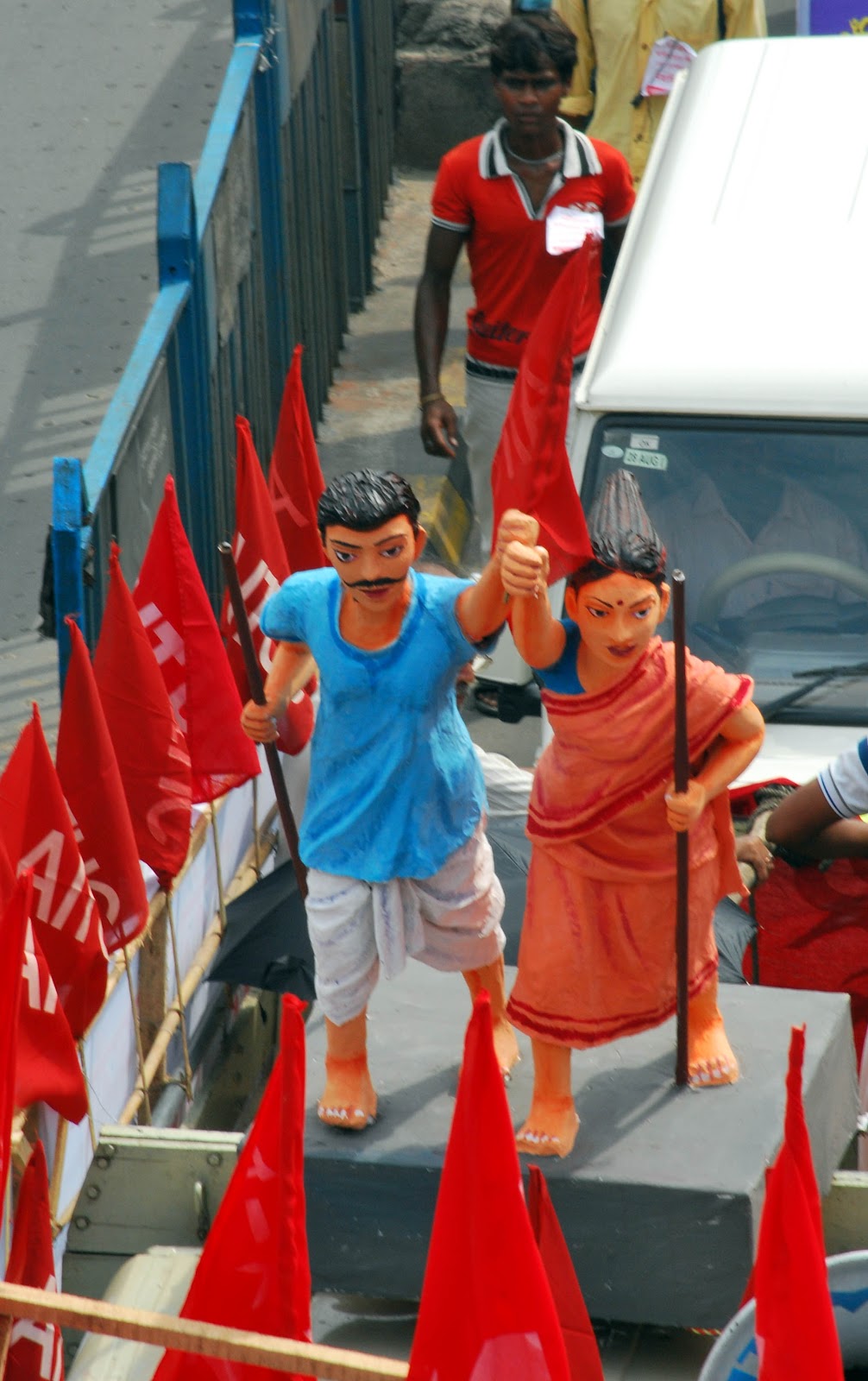
People, mostly from the districts of South Bengal, participated with full of enthusiasm to mark their protest against US aggression and to commemorate the Anti-Imperialist Day of 1st September. The state leaders of Left Front led the rally that started at 1 pm fromRani Rashmoni Road. It took more than two and half hours for the rally to reach Deshbandhu Park, even as the end part of the rally was still waiting at Rani Rashmoni Road. The rally was fully decorated with flags, festoons, and most importantly the mobile tableaus that remained the most attractive part of the rally.   It was exactly 4:30 pm when the last tableau along with people reachedDeshbandhu Park in the northern end of the city. People from all walks of life participated in the rally. Thousands marched with Red flags, once again registering the nature of protest in West Bengal.  

The rally raised voice against US imperialism’s thirst for natural resources in the world, its war crimes in Iraq, Afghanistan, Libya, its interference in South Asia, particularly in Indian economy through FDI in retail sector, privatisation of insurance sector, pension funds etc. The rally raised the voice for defending sovereignty and independent foreign policy of the country.

Addressing the huge gathering at the end of the rally, CPI(M) Polit Bureau member Buddhadeb Bhattacharjee gave a backdrop of USimperialism to correlate the magnitude of the contemporary imperialist aggression in the world. Having mentioned the Atom Bomb attack over Hiroshima and Nagasaki as a birth of today’s US-led imperialism, Bhattacharjee explained the contours of imperialist aggression from Vietnam to present day Iraq. Now the danger of imperialism comes in a different direction when US and allied countries target China and try to set base in India. We won’t tolerate US base in India to blockade India and would launch bigger protests, he said.

Bhattacharjee said that India is trying to set up a strategic partnership or alliance with USA. “What strategic alliance is this? We will protest against any such alliance. US secretary of state Hillary Clinton had made her visit to West Bengal. It was unprecedented for her to visit Writers’ Buildings?  Why did she go there”, he questioned. The state government has also expressed its inclination to invite US president for the youth festival in the state. Bhattacharjee warned of strong resistance if any such eventuality took place.

Left Front chairman Biman Basu while congratulating the people for making the rally a great success said that US corporates are using our markets to meet their internal crisis. “They are trying to control our economy. So we must keep our struggle on against such imperialist aggression. If any of US official comes to commemorate the 150th birth anniversary of Swami Vivekananda on 12th January next year, the state will definitely revolt”, asserted Basu.

Siliguri too witnessed an impressive anti-imperialist rally on the day where at least 10,000 people participated.  

Rallies Planned against Imperialism on September 1


KOLKATA: 1ST September, 1939 was the day when fascist Germany led by Adolph Hitler invaded Poland to start the world's deadliest war till date against humanity. Since then the destruction of life and property continued for five long years - throwing the entire world into war and anarchy. To remind ourselves of the futility and destruction of war, people of the world have been observing 1st September as the World Peace and Anti War Day. West Bengal has a long tradition of observing the World Peace Day. This year is going to be no exception. The Left Front Committee of West Bengal has convened a rally in Kolkata and Siliguri to observe this day.

The non-aligned foreign policy of our country has seemed to be derailed. India has voted for US proposal of strengthening sanctions on Syria in Security Council when even Pakistan dared to abstain. Before that India supported US-British proposal against Iran in International Atomic Energy Agency (IAEA).  India-US military understanding has also been in progress. Despite protests from different corners of the country, the government went ahead with Defense deal, joint army exercises, assistance in military operations etc. India has also endorsed CTBT and civil nuclear treaty. Imperialism now has a direct impact on the life of every Indian citizen and the UPA government in pushing the country to be a junior partner and collaborator of US imperialism. The recent WikiLeaks exposes have also thrown light on how the Indian government has bent to the whims of US imperialism. The pipeline issue with Tehran went under wraps after indirect intervention from US.

The military aspirations of imperialism have been on violent display during recent period. Unresisted, the imperialism would bring the humanity to the verge of destruction once again. There is therefore urgent need to bolster up the flag of humanity and raise our voice in favor of peace and against war. The World Peace and Anti War Day, therefore, is still relevant, stressed the Left Front leaders.

The Left Front’s demands on World Peace and Anti War Day:
       No war but restoration of peace. Imperialism be demolished. US imperialism go back.
       Raise voice against imperialist aggression in several countries
       US -Israel must go back from Palestine
       US imperialism must go back from the Arab world
       US interference in South Asia has to be stopped
       US warships must be removed from the Indian Ocean and Bay of Bengal
       UPA government has to answer for their soft stand against blatant US pressure
       Foil imperialist conspiracies against India. Stop US interference in India
       Resist compromise of sovereignty to the imperialism
       Set aside India’s pro-imperialism foreign policy
       Unite against domination of imperialism in Asia Pacific region
       Set aside the civil nuclear treaty with US
       Gas supply treaty with Iran should not be amended due to US pressure
       Stop US interference in Syria
       Israel has to do away with the illegal capture of Palestine
       Stop US-Israel barbaric activities on Arab people
       India has to stand by Iran against US- Israel conspiracy

Tributes Paid to Comrade Lakshmi Sehgal


KOLKATA: RESPECTFUL tributes were paid to Comrade Lakshmi Sehgal in Kolkata in the commemoration meeting organised by the Left Front on August 14. The meeting, presided over by Left Front chairman Biman Basu, was addressed by Ashok Ghosh, the veteran leader of Forward Block and Subhashini Ali, CPI(M) leader.

Subhashini Ali told about her mother who was dedicated to the cause of downtrodden and the working people. She fondly remembered how her mother used to devote more time for children of toiling people rather than caring for her own daughters. Ali also told that after Comrade Sehgal joined CPI(M) she used to term it as ‘home coming’.

Ashok Ghosh described the outline history of INA and the important role it played in India’s struggle for freedom. ‘Captain Lakshmi Sehgal was the product of a revolutionary struggle against imperialism”, he said.

Biman Basu, in this respect, stressed that the struggle against imperialism has not stopped. In fact, it has assumed greater importance in the backdrop of US hegemonic belligerence and its growing military-political presence in Asia. “Indian ruling classes are subscribing to the imperialist pressure and weakening the sovereignty of the country” , he asserted.

Left Front has called for a mass rally against imperialist designs on September 1. There will be a week-long campaign against imperialism, starting from August 24. The meeting  took oath to carry forward the legacy of Comrade Lakshmi Sehgal through wider struggle against imperialism.

Among others, Buddhadeb Bhattacharjee, Suryakanta Misra, Md Amin, Benoy Konar, Manjukumar Majumdar (CPI), Khiti Goswami (RSP) and leaders of Left parties were present.

Now Judiciary in the Line of Fire from Mamata


KOLKATA: WEST Bengal chief minister Mamata Banerjee hit out at the judiciary on August 14, alleging there were instances when court judgements have been delivered for money. This was a statement made while speaking at a seminar in the Assembly House on the platinum jubilee of the state assembly.

"What I see. Why should many judgements today be delivered for money? Why? I am sorry to say. I am saying this in the Assembly," she said with venom. "One may file a contempt case against me. I will be really very happy. I may be charged with defamation and I may even be arrested. But I will have to give my opinion at some place or the other," the chief minister said.

This comment has not been observed as a general or stray criticism of a section of the judiciary. It was more a reflection of consecutive setbacks for state government in the courts in recent period, which included Singur law.

That the chief minister was merciless for anyone questioning her government has been reflected by her attack against the judicial commissions. Questioning the efficacy and accountability of judicial commissions, the chief minister said "attempts are being systematically made to destroy Constitutional structures.... So much money is spent on these commissions, but the only thing they do is talk to higher officials and do nothing," she added. "The commissions summon the chief secretary, the home secretary, the DGP, the commisisoner of police and they are made to sit for 12 hours," she alleged.

This was her reaction to the strong verdict of state human rights commission regarding the cartoon controversy. The commission has strongly criticised the police action against Professor Ambeksh Mahapatra and his neighbor Subrata Sengupta in April this year for forwarding an e-mail consisting of a cartoon of Mamata Banerjee and Mukul Roy. The commission has directed the state government to pay Rs 50,000 each to both of them as compensation. The commission also directed to initiate departmental proceeding against the police officers.

The chief minister’s intolerance to any amount of criticism has now spread to judiciary. But it has evoked strong reactions from different quarters in the country. "It is a serious allegation against the entire judiciary, which is very irresponsible, especially for a chief minister," Supreme Court Bar Association president Pravin Parekh said. He said SCBA has not taken any decision to move the court against the remarks made by the chief minister. He, however, said he has heard that some petition is likely to be filed. Parekh said there is an option to move the Supreme Court or the Calcutta High Court for contempt and also for seeking damages.

"What about the cases, she has won in court? Who paid the judges? Mamata? This shows the absurdity of the allegations. I mean, one expects a mature reaction...I am very very disturbed," eminent lawyer Soli Sorabjee said. Retired Justice Santosh Hegde, who was once Lokayukta of Karnataka,  said the chief minister should have been more prudent. "...If this is going to be the tone and tenor of Indian democracy, then I think our Constitution is in serious peril," senior Supreme Court advocate Harish Salve said. Terming as "highly irresponsible" Banerjee's statement, Constitutional expert and lawyer P P Rao said, "this is not expected from a person holding a responsible position". 

On the Occasion of Golden Jubilee of Deshhitaishee


By Sitaram Yechury

(The following is the text of the speech delivered by Sitaram Yechury, Polit Bureau member of the CPI(M) in Kolkata on August 16, 2012 on the occasion of Golden Jubilee of Deshhitaishee.)

REVOLUTIONARY congratulations to the West Bengal state committee of the CPI(M) for successfully completing fifty years of publication of the Party weekly Deshhitaishee.  This golden jubilee has come facing many trials and tribulations imposed by evolving contemporary political developments that had demanded many a sacrifice of life and limb of thousands of our comrades.  Revolutionary red salute to our martyrs.  It is, indeed, a matter of immense satisfaction that we are today commemorating this golden jubilee.  

I

The importance of the Party paper can never be undervalued.  Vladimir Lenin who provided leadership for ushering in humanity’s transition from capitalism to socialism had in 1901 said in “Where to begin?”: “In our opinion, the starting-point of our activities, the first step towards creating the desired organisation, or, let us say, the main thread which, if followed, would enable us steadily to develop, deepen, and extend that organisation, should be the founding of an All-Russian political newspaper. A newspaper is what we most of all need; without it we cannot conduct that systematic, all-round propaganda and agitation, consistent in principle, which is the chief and permanent task of Social-Democracy in general and, in particular, the pressing task of the moment … Never has the need been felt so acutely as today for reinforcing dispersed agitation in the form of individual action, local leaflets, pamphlets, etc., by means of generalised and systematic agitation that can only be conducted with the aid of the periodical press… Without such a newspaper we cannot possibly fulfill our task – that of concentrating all the elements of political discontent and protest, of vitalising thereby the revolutionary movement of the proletariat.”

Further he says: “The role of a newspaper, however, is not limited solely to the dissemination of ideas, to political education, and to the enlistment of political allies. A newspaper is not only a collective propagandist and a collective agitator, it is also a collective organiser.”

Later in “What is to be done?”, Lenin says: “This newspaper would become part of an enormous pair of smith’s bellows that would fan every spark of the class struggle and of popular indignation into a general conflagration. Around what is in itself still a very innocuous and very small, but regular and common, effort, in the full sense of the word, a regular army of tried fighters would systematically gather and receive their training.”

II

Many, however, say that the civilisational advances of the 20th century, particularly the scientific and technological advances, have so completely transformed the situation that instantaneous communication is today possible in a manner that would be incomprehensible at the beginning of the 20th century.  The emergence of radio and television with the latest invasion of cyberspace and cell phones, some argue, has rendered the newspaper as an obsolete means of communication.  Therefore, they would ask if there is any point in recollecting Lenin’s views on the Party newspaper.

Notwithstanding these advances, the importance of the Party newspapers does not merely remain but has grown multifold to meet the current challenges. In every age and time, the ruling classes have always consolidated their class rule by exercising an ideological hegemony over contemporary society.  As Marx and Engels said, “The ideas of the ruling class are in every epoch, the ruling ideas: i.e., the class which is the ruling material force of society is at the same time its ruling intellectual force. The class which has the means of material production at its disposal, consequently also controls the means of mental production so that the ideas of those who lack the means of mental production are on the whole subject to it. The ruling ideas are nothing more than the ideal expression of the dominant material relations; dominant material relations, grasped as ideas: hence of the relations which made the one class the ruling one, therefore, the ideas of its dominance. The individuals composing the ruling class possess among other things, consciousness and therefore think. In so far therefore, as they rule as a class and determine the extent and compass of an historical epoch, it is self-evident that they do this in its whole range, hence among other things rule also as thinkers, as producers of ideas, and regulate the production and distribution of the ideas of their age; thus their ideas are the ruling ideas of the epoch.” (German Ideology, Moscow 1976, p. 67 emphasis added.)

It is this hegemony of the `ideas' of ruling classes that as Gramsci explains is not enforced merely by the State. The State is only the "outer ditch" behind which stands a powerful system of "fortresses and earth works", a network of cultural institutions and values which buttress the rule and domination of the ruling classes.

Under capitalism, while culture as an ideological formation bolsters the rule of capital, the forms of culture go through a process of commodification, as everything else in society. Much has been written about this process and needs no repetition. The cultural products of capitalism are aimed at achieving social control rather than expressions of social creativity. The exchange value of these products always supersede their use value. This, of course, does not hold for those cultural products that emerge from dissent and opposition to capitalism...The cultural hegemony that such a globalisation process seeks is expressed in the need to create a homogenisation of public taste. The more homogenous the taste the easier it is to develop technologies for the mechanical reproduction of `cultural products' for large masses. Commercialisation of culture is a natural corollary of such globalisation.

Viewed in terms of class hegemony, the culture of globalisation seeks to divorce people from their actual realities of day to day life. Culture here acts not as an appeal to the aesthetic, but as a distraction, diversion from pressing problems of poverty and misery. Consequently, it seeks to disrupt the energy of the people and their struggle to change and improve their miserable existence. As Michael Parenti says, "A far greater part of our culture is now aptly designated as "mass culture", "popular culture", and even "media culture", owned and operated mostly by giant corporations whose major concur is to accumulate wealth and make the world safe for their owners, the goal being exchange value rather than use value, social control rather than social creativity. Much of mass culture is organised to distract us from thinking too much about larger realities. The fluff and puffery of entertainment culture crowds out more urgent and nourishing things. By constantly appealing to the lowest common denominator, a sensationalist popular culture lowers the common denominator still further (media page 3 culture). Public tastes become still more attuned to cultural junk food, the big hype, the trashy, flashy, wildly violent, instantly stimulating, and desperately superficial offerings.

"Such fare often has real ideological content. Even if supposedly apolitical in its intent, entertainment culture (which is really the entertainment industry) is political in its impact, propagating images and values that are often downright sexist, racist, consumerist, authoritarian, militaristic, and imperialist." (Monthly Review, February 1999)

Media culture that globalisation promotes is starkly exposed by the manner in which it underrates or outrightly ignores people’s protests and their conditions of miserable existence.  For instance, the very day when team Anna was holding their hunger strike on issue of corruption, over two lakhs of workers at the call of the All India Trade Unions had marched to the parliament in Delhi protesting against price rise and corruption.  While the former hogged the headlines and dominated the electronic media, the action of the working class was largely ignored. Adding insult to injury, the Times of India, in an obscure page carried a small news item bemoaning the traffic disruption caused by the worker’s rally in the country’s capital!  Yet again, in July this year, the five-day dharna by the Left parties demanding food security for our people was again largely ignored while team Anna’s movement that finally fizzled out taking place next to the Left parties dharna, once again hogged the headlines and the electronic media attention.  

Nearly a hundred and fifty years ago, Marx in his analysis of capitalism made a very penetrating observation. "Production not only provides the material to satisfy a need, but it also provides the need for the material. When consumption emerges from its original primitive crudeness and immediacy -- and its remaining in that state would be due to the fact that production was still primitively crude – then it is itself as a desire brought about by the object.  The need felt for the object is induced by the perception of the object.  An object d'art creates a public that has artistic taste and is able to enjoy beauty – and the same can be said of any other product. Production accordingly produces not only an object for the subject, but also a subject for the object. (Karl Marx, "Introduction" to Economic Manuscripts of 1857-58) (Emphasis added.)

The billions of dollars spent annually on advertising are creating the `subjects' for the `objects' that the system churns out. Likewise in culture. The audience is first created to receive a product of mass consumption. The homogenisation of public tastes is thus created through an advertisement blitz that dullens if not erases critical faculties. It is not therefore, as though, this `culture' is catering to people's taste. Tastes and ideas are being created to accept uncritically the `culture' that is being churned out.

How does one then combat such a cultural onslaught? An onslaught that drives away truly popular people's culture. At the first instance, it is necessary to bring back on to the cultural agenda people's issues, whose obfuscation and erasure is the raison d'etre of the culture of globalisation and communalism. This is paramount to counter the cultural hegemony that they seek.

III

The current situation in which we are conducting our political activities today is dominated by imperialist globalisation.  The CPI(M) 20th Congress Ideological Resolution notes:

“The ideological war to establish the intellectual and cultural hegemony of imperialism and neo-liberalism has been on the offensive during this period. Aided by this very process of globalisation and the vastly elevated levels of technologies, there is convergence of information, communications and entertainment (ICE) technologies into mega corporations. This monopolisation of the sphere of human intellectual activity and the control over dissemination of information  through the corporate media is a salient feature of this period that seeks to continuously mount an ideological offensive against any critique or alternative to capitalism. The cultural hegemony that such a globalisation process seeks is expressed in the need to create a homogenisation of public taste. The more homogenous the taste, the easier it is to develop technologies for the mechanical reproduction of ‘cultural products’ for large masses. Commercialisation of culture is a natural corollary of such globalisation. Viewed in terms of class hegemony, the  culture of globalisation seeks to divorce people from their actual realities of day to day life. Culture here acts not as an appeal to the aesthetic, but as a distraction, diversion from pressing problems of poverty and misery.”

The development of ICE technologies and the control over them, also allows imperialism to develop and maintain sophisticated surveillance technologies. Such technologies are being increasingly used to monitor, influence and sabotage a large variety of popular movements that challenge the hegemony of imperialism.

For instance, the mega corporation Time had earlier merged with the entertainment giant Warner Bros. The information giant American Online Ltd (AOL) has now acquired Time-Warner at a cost of $ 164 million to become the largest ICE conglomerate in the world. Rupert Murdoch now commands a combined news, entertainment and internet enterprise which is valued at $ 68 billion. Likewise, Walt Disney has now acquired Marvel (of Spiderman fame). The cultural products that are universally created are bombarded across the world garnering phenomenal profits. As recently as in January 2011, Comcast Corp has completed its takeover of NBC Universal,  creating a $ 30 billion media behemoth that controls not just how television shows and  movies are made, but how they are delivered to people’s homes. Comcast, the No. 1 provider of video and residential internet service in the United States (with over 23  million video subscribers and nearly 17 million internet subscribers), acquired a 51 per  cent stake in NBC Universal from General Electric Co. The newly created joint venture is  called NBC Universal LLC and its assets include NBC broadcast stations, cable channels like Bravo, USA and E!, the Universal movie studio as well as theme parks among other  assets.

Some instances in the Indian context: Reliance Entertainment (formerly known as Reliance BIG Entertainment) is a wholly owned subsidiary of the Reliance Anil Dhirubhai Ambani Group, its media and entertainment business, across content and distribution platforms. The key content initiatives are across movies, music, sports, gaming, internet and mobile portals, leading to direct opportunities in delivery across the emerging digital distribution platforms:  digital cinema, IPTV, DTH and Mobile TV. Reliance ADA Group acquired Adlabs Films Limited in 2005, one of the largest entertainment companies in India, which has interests  in film processing, production, exhibition and digital cinema. Having won 45 stations in the bidding, BIG 92.7 FM was India’s largest private FM radio network. Big Cinemas is India’s largest cinema chain with over 516 screens spread across India, US, Malaysia and Netherlands. The chain caters to over 35 million consumers. BIG Cinemas has established leadership in film exhibition in India with 253 screens and accounts for 10 to 15 per cent of box office contributions of large movies.  The company forayed into the largely untapped video rental market in India by acquiring  Big Flix and started further expansion. In April 2008, Reliance Big Entertainment acquired DTS Digital Images, a digital film restoration company based in Burbank, California. On 15 July 2009, Reliance Big Entertainment and Steven Spielberg announced a joint venture with a funding of $ 825 million. Recently, Big 92.7 FM  launched a radio station in Singapore considering 8 per cent of the population residing there is  Indian. On January 15, 2010, Reliance reportedly joined the bidding for MGM. On April 5, 2010, they acquired a 50 per cent stake in Codemasters.  Reliance had invested about 26 billion rupees in Eenadu Group's regional TV channels when it announced the deal with the TV18 group's Network18 on January 3, 2012.  Reliance holds a 100 per cent economic interest in five ETV regional news channels and five ETV general entertainment channels. It also owns a 49 per cent economic interest in  ETV Telugu and ETV Telugu News.

Such mega corporatisation of media is playing havoc with distorted dissemination of information and deliberate campaigns of disinformation.  The rise of the phenomena of `paid news’ shows the extent of commercialisation of media.  Truth and objectivity are the casualties that buttress the hegemony of the ruling classes.

IV

This monopolisation of media as a weapon of ideological hegemony that the ruling classes unleash needs to be combated much more aggressively.  New ideological postulates like post-modernism are aggressively propagated.  Its main thrust, as with all other anti-Communist ideological expressions of the past, is the negation of classes and, hence, of class struggle.  It seeks to compartmentalise society in terms of ethnic, regional and other micro identities and, thus, disrupt the unity of the exploited classes.  Such theories, therefore, weaken the class unity of the exploited people and, thus, buttress the class rule of the exploiters.  

The Party newspaper, along with other forms of media, today has to  rise to meet such challenges and, therefore, act as a powerful weapon in the hands of the  revolutionary forces to propagate their ideas, to organise the exploited classes and, thus, to strengthen  the struggle  for creating a society free from all forms of exploitation – socialism.

I am confident that Deshhitaishee will continue to play its role and will rise to effectively meet and combat the current challenges. 

Exhibition on PS in Muzaffar Ahmad Library


KOLKATA: ON the occasion of birth centenary of Comrade P Sundarayya, an exhibition on his life and work was inaugurated in Muzaffar Ahmad library in Ganashakti Bhavan. The poster exhibition was inaugurated on August 5, the birthday of Comrade Muzaffar Ahmad.

In the exhibition, outline of PS’s life from his childhood has been portrayed through photos and graphics. His extraordinary work among the masses, the period of first expansion of the Communist Party in southern India were highlighted through excerpts from different books. A great part of the exhibition is obviously devoted to Telengana Peoples’ Armed Struggle. PS’s role in the fight against revisionism, then again against sectarianism has been detailed. Along with posters, some of his books and Bengali translation of his pamphlets have been displayed. His important articles in Peoples’ Democracy and other Party organs were displayed as photographs.

Biman Basu inaugurated the exhibition. CPI(M) state leaders were present. The exhibition will continue in Ganashakti Bhavan upto August 12. However, according to suggestions by senior Party leaders, the exhibition may travel to districts.

West Bengal state committee of CPI(M) has decided to observe PS birth centenary in a fitting manner, specially through programme of Party education. On September 14, there will be a central public meeting in Kolkata to be addressed by Party general secretary Prakash Karat.

3 DAY SIT IN DEMOSTRATION OF LEFT FRONT IN KOLKATA


KOLKATA: The Left Front in West Bengal observed three day sit-in demonstration in Kolkata from August 1 demanding food security for all. The sit-in took place in Rani Rashmoni Road. At the beginning Left Front chairman Biman Basu addressed the gathering. He criticised the centre’s dilly-dallying with food security bill. He demanded universal PDS throughout the country.

Leader of opposition in Bengal assembly, Suryakanta Misra said that USA and international finance capital was pressuring the Indian government to follow a policy of export of cash crops, which would bring disaster for food security of our people. He castigated the state government for its failure in addressing the crisis in agricultural production, fair prices for the farmers and for the spiraling price rise as well.

The second day of the sit-in was vibrant with participation of mass organisations. CITU, SFI, DYFI, AIDWA activists joined in the demonstration. Among others Shyamal Chakraborty, Minati Ghosh, Abhas Roychowdhury, Sayandip Mitra addressed the sit in.

On the last day CPI(M) Polit Bureau member Buddhadeb Bhattacharjee, in his address, said the policies of central government were primarily responsible for the unabated price rise. The centre’s policy of letting everything work according to market forces has led to such a situation. We want subsidy for the people, not for the richer sections in the form of tax relief. The struggle for food security will continue, he asserted.

Biman Basu expressed concern about deteriorating agricultural production in West Bengal. Among others Manjukumar Majumdar (CPI), Jayanta Roy (Forward Block), Kalyan Mukherji (RSP), Shyamali Gupta (CPI-M) addressed the gathering. 

During these three days thousands of people participated in the sit in in districts as well. The Left Front has decided to campaign on food security throughout the month of August.


Ganashakti Under Attack: Call for Fund Raising from People


KOLKATA: IN the bizarre media scenario in West Bengal, where almost all business newspapers and channels, except a handful, are brazenly anti-Left, the only viable and steady alternative is Ganashakti, the CPI(M) daily organ that has a broad readership and broader acceptance among people for decades.

In the changed political scenario in the state, Ganashakti has practically become the sole voice raising questions about the functioning of the state government, depicting the atrocities being committed against the peasants, workers, women and other democratic sections of people. It has already exposed corruption, nepotism and utter failures of the TMC-Congress government. Naturally, Ganashakti has also become a target for attack.

In fact, for the last 14 months Ganashakti has been facing fierce attack of the ruling parties of West Bengal. From urban belt to rural belt, the attacks were everywhere. The attacks were initiated all over the state just after the declaration of results of the assembly election. The ruling party activists immediately started threatening and also initiated attacks in many areas to stop the sale and circulation of Ganashakti. It was declared as ‘banned’, hawkers were attacked, and even the packets of the daily  were burnt.  Several boards of Ganashakti were dismantled by the anti-socials. Yet, the circulation and sale of the daily continued under such difficult situation. The readers’ increasing interest toward Ganashakti is also evident.

Beside the physical attack, the state government, in a completely illegal move, stopped issuing advertisements to Ganashakti. Even private institutions that are issuing advertisements to the daily are facing direct or indirect threats from the ruling party. So, Ganashakti has been facing huge financial loss for the last one year. Moreover, the devaluation of the rupee in comparison to dollar has resulted in a steep increase in the price of newsprint. Allied expenditures have also increased.

In these circumstances, the CPI(M) West Bengal state committee has given a call for collecting fund for Ganashakti from people. Party state secretary Biman Basu, in an appeal, said that Ganashakti has been playing its role even amidst these multidimensional attacks. It is only this daily that has been regularly taking initiatives to protect the interests of poor people including the workers and peasants and also effectively exposing the attacks on democracy. Through its news, features, articles and special contributions Ganashakti has been instrumental in revealing the undemocratic face of the state government.

Basu said that Ganashakti has been resolutely continuing the fight against the anti-people policies of the central government. It has been operating as the only alternative newspaper when almost all business newspaper groups are playing anti-Left role and eulogiser of TMC and Congress. Daily newspapers and other organs of Communist Party have always tried to portray the real picture of the society to the largest possible reach. Ganashakti has the rich inheritance of Janajudhha and Swadhinata publications. The common people have always extended assistance in publication and management of the organs of the Communist Party. The people of West Bengal protected Ganashakti during Emergency. In those dark days many people risked their lives to render support for Ganashakti. The support of the readers helped it to overcome stiff hurdles.

Basu appealed to workers, sympathisers of Left forces, common people and above all the readers of Ganashakti to stand by the daily in this adverse situation. Fund raising to support Ganashakti will be organised in the entire month of August. Basu expressed confidence that Ganashakti will continue to play a strong role to bolster the right to freedom of expression of the democratic people of West Bengal in the future.

Mamata’s Singur Law Declared Unconstitutional


CPI(M) Wants Fair Resolution

KOLKATA: THE Mamata Banerjee government received a jolt when the Calcutta High Court declared its Singur Land Rehabilitation and Development Act 2011 as illegal and unconstitutional. The state government had passed the act on June 13, 2011, exactly a month after the assembly poll results were declared, among apprehension that the move was not legally valid. On September 28, after a challenge by Tata Motors, a single judge bench of the Calcutta High Court upheld the validity of the act. But on June 22 of this year, Justices Pinkai Chandra Ghose and M K Chaudhury ruled that the act violated the constitution on three counts. First, it did not have presidential assent. Second, returning land to the original owners did not constitute public interest, and hence the land could not be vested by the government. And third, the act did not have any provision for compensation to Tata Motors for the losses they have suffered.

MOVE ILL-CONCEIVED FROM BEGINNING
The move by the state government was ill-conceived from the very beginning and it was more of a publicity stunt than any real intention to solve the Singur issue. The face of loss in court was compounded by the governor’s assertion that he had no idea that Singur legislation needed presidential approval. The governor said he had been given a legal advice on that line only. “I thought we did not require presidential approval. That was legal advice also,” Governor M K Narayanan told after three days of the court verdict. The governor’s public statement indicated that the state government had misled even him.

While criticising the attitude of the government, the CPI(M)  called for such a resolution of the problem as would defend the interests of the people of Singur.

CPI(M) Polit Bureau  member and West Bengal’s former industry minister Nirupam Sen observed that there should be a fair solution of the Singur problem without considering who had won or who was defeated. Sen said, “The factory in Singur was abandoned after completion of 90 per cent of works. It damaged the image of the state. Also damage was done to the people of Singur.”

Sen further said, “When we were in government, the then opposition (now ruling party) demanded return of land to the so called unwilling farmers. We took legal consultancy and observed that it was legally impossible. We wanted to start the factory after giving fair compensation to and rehabilitation of the farmers. But we failed to convince the opposition. We repeatedly told at that time that the so called unwilling farmers of ‘400 acres’ were just a myth. But a huge campaign by the opposition and a section of the media created confusion. Now that the new government has taken initiative to return the land, it was found that hardly 30 acres of land of the ‘unwilling’ farmers exist in realty. The entire state had to bear the cost of abandoning the project. When the new government wanted to push through the new bill in the assembly, we raised doubts about its legal validity. We told them to move after checking the legal points. But they refused to heed. And now the people of Singur are the worst sufferers as they lost both the factory and the land.” Sen appealed to the state government to take proper lessons and move forward in a manner so that an industry could be built there.

Leader of opposition in West Bengal assembly, Surjya Kanta Misra, said in his reaction to the court verdict, “We were for industry in Singur. But we were defeated. TMC has got the mandate of the people. In such a situation we did not oppose the move to return land if that was possible. But we repeatedly told the government, a year ago when the bill was moved, that proper legal method was necessary. We told the government that their hasty effort would come into conflict with the central law. There was no provision of differentiation between willing and unwilling farmers. It was better to add an extra clause to the central law, like Tamilnadu did. But the chief minister was not in the habit of listening to any advice. She thought her words were law. It is the state government which created the impasse.”

CPIM) state secretary Biman Basu criticised the state government for not heeding to advice of the opposition and not taking care about legal implications. Basu also questioned how the governor gave his assent without cross checking the legal option.

August 1, 2012

TMC MLA clarifies 'short skirt' remark, Mamata refuses comment


IANS, Jul 28, 2012 at 11:34pm IST

Kolkata: West Bengal Chief Minister Mamata Banerjee on Saturday refused to comment on a statement made by actor and Trinamool Congress legislator Chiranjeet that short dresses worn by women were one of the reasons behind the increase in incidents of harassment.

"I don't know anything about it," Banerjee said when asked to comment on the statement made by her party MLA.

However, after facing criticism, Chiranjeet tried to clarify his statement.

"I had said that keeping in mind the well-being of the teenaged girls. The comments are nothing but reflections of the concerns that a father, elder brother or a guardian has regarding their teenage daughters or sisters," he said.

Earlier in the day, Chiranjeet aka Dipak Chakraborty, the legislator from Barasat in North 24-Parganas, had said that short dresses worn by women are one of the main reasons behind the increase in incidents of harassment of women in his constituency.

His comments came a day after a girl was harassed in the area.

"Eve-teasing is a very old thing. It has been going on for ages. One of the reasons behind the increase in incidents of eve-teasing is short dresses and short skirts worn by women. This in turn instigates young men," he had said.

"The incident of eve-teasing is not good. We condemn it but we need to see one thing that there can be no Ramayana without a Ravan," he had said.