September 23, 2012

Mamata walks out of UPA II, Trinamool ministers to resign on Friday


DNA, Published: Tuesday, Sep 18, 2012, 17:42 IST

We will hit the streets to protest against the government decisions, Bannerjee said.
Tuesday, Sep 18, 2012 20:40 IST

This government will last only three to six months, she said, adding thatTrinamool Congress was the biggest party in the UPA alliance.
Tuesday, Sep 18, 2012 20:38 IST

Trinamool Congress ministers will resign on Friday, said party chief Mamata Banerjee.
Tuesday, Sep 18, 2012 20:32 IST

Mamata Banerjee says Trinamool Congress withdraws its support form the UPA government.
Tuesday, Sep 18, 2012 20:29 IST

Mamata Banerjee:
The government did not consult us before fuel hike.
We have always been snubbed by the government.
UPA has no respect for us.
We cannot stay happy if our heads are cut off.
The central government has always discriminated against West Bengal.
Our ministers will resign fromt he centre tomorrow.
Trinamool Congress withdraws its support from UPA II.
We are doing this for the common man.
We are very proud of what we are doing.
Tuesday, Sep 18, 2012 20:24 IST

Mamata Banerjee is currently addressing the media.
Tuesday, Sep 18, 2012 20:21 IST

Mamata Banerjee will be addressing the media shortly to announce the decision taken in the meeting.
Tuesday, Sep 18, 2012 19:33 IST

The Trinamool Congress meeting in Town Hall has ended.
Tuesday, Sep 18, 2012 19:30 IST

After Sonia Gandhi, Finance Minister P Chidambaram will also be meeting the prime minister.
Tuesday, Sep 18, 2012 19:11 IST

West Bengal Congress chief said that Mamata Banerjee will not pull out of UPA.
Tuesday, Sep 18, 2012 18:24 IST

Meanwhile, MNS has declared that they will be supporting FDI in multi-brand retail.
Tuesday, Sep 18, 2012 18:07 IST

There are also reports that a cabinet reshuffle is on cards.
Tuesday, Sep 18, 2012 17:45 IST

Reports coming in that Congress chairperson is currently on her way to Prime Minister Manmohan Singh's house to discuss the Trinamool crisis.
Tuesday, Sep 18, 2012 17:45 IST

Congress leader Renuka Choudhury said they are talking to Mamata Banerjee and that she will understand their stand.
Tuesday, Sep 18, 2012 17:41 IST

Crucial meeting of Trinamool Congress parliamentary party to decide party's stand on hiked diesel price, LPG and FDI is currently underway in Kolkata.
Tuesday, Sep 18, 2012 17:39 IST
         

Tapan Sen, MP, General Secretary, CITU writes to Petroleum Minister


Dear Shri S Jaipal Reddy ji,

I draw your urgent attention to the statement of Ministry of Petroleum & Natural Gas published as advertisement in the leading National Dailies today on 17th September 2012 under the heading “Was the increase in price of diesel & capping of Domestic LPG avoidable? No, for the following reasons:” (copy enclosed)

I totally disagree with the “reasons” detailed therein but that is not the purpose of drawing your attention here.

The point is that the said statement published by the Ministry suffers from misrepresentation of facts when it referred to the recommendation of the ‘all party Standing Committee of Parliament on Petroleum & Natural Gas on ‘capping of domestic LPG’.

Number one, the recommendation of the Standing Committee on Petroleum & Natural Gas (8th Report on Demands for Grants-2011-12) on this particular issue was not at all unanimous as has been claimed in Ministry’s advertised statement. I as a member of the Standing Committee, had submitted my ‘note of dissent’ on the recommendation on this particular issue which was published along with the Report and tabled in Parliament on 03-08-2011.

Number two, the decision of the Govt capping the domestic LPG cylinders’ availability to 6 cylinders annually for all households is at wide variance with what the Standing Committee actually recommended on that issue, contrary to what has been stated in Ministry’s advertised statement. The Standing Committee recommended, though not unanimously, the restriction on domestic LPG availability at subsidized rate for “people having an income of more than Rs Six Lakh per annum including those holding constitutional posts, public representatives like MPs, MLAs/MLCs.”

Let me again reiterate, I am not arguing here on the merit of what the Ministry sought to convey to people through this advertised statement. I like to state here only that such official statement of the Ministry of Petroleum & Natural Gas, that too published as advertisement in all the national dailies should not indulge in misrepresentation of facts as pointed out in the preceding paragraphs.

I would request you to please look into the matter and do the needful so that corrective action is taken at the earliest to put the facts straight and without distortion or dilution.

With regards,

Tapan Sen

17th September 2012

Match-fixing' by Cong, Trinamool on diesel hike: Karat


TNN | Sep 15, 2012, 06.11AM IST

KOLKATA: CPI(M) general secretary Prakash Karat on Friday termed Trinamool Congress claims of not being consulted on the diesel and LPG price rise as "match-fixing". "Three days back the Cabinet Committee of Political Affairs (CCPA) had said it was to figure on its agenda. Trinamool is part of the committee. They will skip not attend the cabinet meeting and then say take a plea that they were not told," Karat said.

"The Trinamool Congress is an ally of the UPA. And no such decision can be taken without taking the allies in confidence. Congress doesn't have a majority," Karat said while speaking at a party function to commemorate the birth centenary celebrations of CPI(M)'s founder general-secretary P Sitaramaiah at Pramode Dasgupta Bhawan.

Earlier, speaking to the reporters at the NSCBI airport, Karat said: "The CPI(M) will hold discussions with other parties before launching a stir pressing for a rollback. Both the decisions of hiking the diesel price and restricting the supply of subsidized cooking to six cylinders per household in a year will hit the common man hard. CPI(M) has already criticised the decision of the Centre. We are going to discuss with other parties as to how to organise a common movement to demand the rollback of the decision."

Karat's statement also found resonance in the CPI(M)'s three-day extended state committee meeting, which began on Friday. In a statement, CPI(M) not only stopped at saying that Trinamool can't shun from its responsibility, it also said till the time the Centre makes a rollback, the state can very well withdraw the state component embedded in the prices. "The state also stands to benefit from the price increase," it said. Left Front chairman Biman Bose has already announced a series of agitation programmes in the state from Saturday.

State Congress president Pradip Bhattacharya also pointed why Union railway minister Mukul Roy chose to remain absent from the crucial cabinet meetings. "We all know it is a tough decision but sometimes tough decisions need to be taken. Trinamool, being our ally at the Centre, needs to be more sensible rather than trying to score political points " Bhattacharjee added. "

If they plan to launch agitations against the central government, then we can also launch stir against the wrongdoings and policies of the state government," Bhattacharjee added. Asked about the TMC's charges of not being informed about the decision, he said: "This is rubbish. They have a cabinet minister (Mukul Roy). All the important decisions are taken in the cabinet. Why does he always remain absent from the cabinet meeting?"

"Does he need a special invitation to be present at the cabinet meeting? Most of the times when there is a cabinet meeting, he stays in Kolkata and then Trinamool will say they were not informed. What is this?" he said.

BJP workers, on Friday morning, burned the effigy of PM Manmohan Singh and blocked roads in several parts of the state demanding rollback of diesel price hike and restoration of full subsidy on LPG cylinders.

How is Trinamool ignorant of every hike, asks Karat


KOLKATA, September 14, 2012
Communist Party of India (Marxist) general secretary Prakash Karat on Friday described as “peculiar” the pattern of West Bengal Chief Minister Mamata Banerjee pleading ignorance every time a fuel hike was announced and saying she was opposed to the move even as her party, a constituent of the ruling UPA, failed to attend the meetings where the crucial decisions were taken.
“There is some sort of match fixing in this. They [the Trinamool Congress] say, ‘you [the Congress] go ahead [with the imposition of the hike], we will say we did not know anything about this.’ This is the approach the Trinamool-led State government has adopted,” Mr. Karat said, speaking at a function in the city to mark the birth centenary of P. Sunderayya, first CPI(M) general secretary.
“They [the Trinamool] say we were not told; we were not consulted; we are opposed to it. But there was a meeting of the Cabinet Committee for Political Affairs and on the agenda were increase in diesel prices and limiting the subsidy for LPG cylinders. The Trinamool representative in the Cabinet [Railway Minister Mukul Roy], who is a member of the CCPA, did not attend that meeting.”
Mr. Karat said the Trinamool pleaded ignorance of the proposed hike even after the agenda of the meeting had been published in the media.
“If they were opposed to it, the Minister should have gone to the CCPA. They should have blocked it in the Cabinet.” The Congress, he said, did not have a majority and could not proceed with a decision if any of the allies opposed it.

Mamata govt superseding elected local bodies: CPI(M)


Zee News, Last Updated: Thursday, August 23, 2012, 18:38

New Delhi: Accusing the Trinamool Congress of "absolute authoritarianism", the CPI(M) on Thursday charged the Mamata Banerjee government with superseding elected local bodies in West Bengal and giving all their financial powers to district magistrates, thereby stalling development work.

"The state government has issued orders ceasing the powers of the zilla parishads of North 24 Parganas and Nadia districts. Under the orders, the DMs will now operate all powers of the parishads and sanction schemes," senior party leader Sitaram Yechury told reporters here.

"This is absolute authoritarianism and autocratic manner in which the state government is functioning," he said.

A CPI(M) delegation of zilla parishad representatives, led by Yechury and former MP Amitabha Nandi, took up the issue with Panchayati Raj Minister Kishore Chandra Deo and Rural Development Minister Jairam Ramesh at separate meetings.

Nandi said though panchayat was a state subject and his party was opposed to any move by the Centre to interfere in state matters, "in this particular case, I believe it has become necessary to have an exception as a very special case".

He said all public works in Nadia and North 24 Parganas "have come to a standstill since the state government order became operative".

The delegation sought the intervention of the two Union ministers to take appropriate action to end the deadlock. (PTI)

Is Mamata giving communal politics a chance in Bengal?


Written by: Shubham Ghosh

ONE INDIA, Updated: Tuesday, September 4, 2012, 10:41 [IST]

Mamata is often heard of shouting "Don't let them start riots in Bengal!." Who are "they"? Where is riot happening in Bengal? On the contrary, an educated middle-class led by a secular Leftist leadership nurtured a socio-economic culture in Bengal which was not traditionally characterised by caste and minority politics. But in the post-Left Front times, we are clearly seeing how casteist politics is making its way in the Bengali society. We have seen how the Matua sect and Muslims are being mobilised by the Mamata Banerjee, the latter in a more fragmented way.

Mamata encouraging communal forces
The BJP, which has never succeeded in fomenting a communal way of politics in the state, has been feeling encouraged only because Mamata, today, is intending to appease the minorities. We all know soft communalism in the name of secularism will eventually lead to the growth of a hard, reactionary communalism. The Congress's ploy and the BJP's rise as a counter-force have left such examples in the past. The recent protest over the construction of Aligarh Muslim University campus in Murshidabad is a classic case.

The BJP wouldn't have to sweat it out if Mamata continues with her appeasement policy for another three-and-half years and beyond (for I believe that she will come back to power in 2016 even if with a reduced majority). Mamata, instead of focusing on overall uplift of the minorities, is actually playing a dangerous game of fragmenting the minorities by extending facilities to selected sections.

What will an allowance for the Imam do for the uplift of an average educated middle-class Muslim person? He, or she, just like any educated middle-class Hindu, will want industrialisation in the state for generation of economic opportunities. There is no point in slamming the BJP for trying out 'communal politics'. It is being given such an opportunity.

Bureaucrats see it better and clearly
If a police officer, owing to the fact that he has seen it all from close ranks, decides to write on issues he strongly feels about, then who are these chamchas to oppose? Mamata can not accuse Islam as CPI(M)'s man either for he was known for his clashes with it also. People like Ghosh and Islam have dared to expose the so-called tamasha that is going on in Bengal today in the name of pro-people action and it is natural that the state machinery would be unleashed against them in a desperate bid to keep its artificial support base intact.

Islam's daring act could also hint at the growing dissent in the Bengal police against the maladministration of Mamata. The CM, who was once at the receiving end of the fury unleashed by the police during the days of the Left rule, has transformed it into a stooge of her own. She has defended criminals belonging to own party while discouraged honest officers from properly carrying out their job (she once allegedly got a few of her followers freed from police lock-up after they were arrested for threatening the police and reprimanded officers), the normal consequence of what has been the deteriorating law and order situation.

The culture that is being nurtured by Mamata Banerjee in Bengal is a shocking one. Even as people regard her government's action as anti-democratic, it is more threatening somewhere deep down. But who can arrest the slide when the protector itself turns draconian?

FEAR OF FREEDOM


Zero tolerance


By SUHRID SANKAR CHATTOPADHYAY

FRONTLINE, Volume 29 - Issue 17:: Aug. 25-Sep. 07, 2012

Chief Minister Mamata Banerjee’s absolute intolerance of criticism resurfaces with the arrest of a farmer.


Mamata Banerjee. Her apparent paranoia has made her overdependent on the police.

West Bengal Chief Minister Mamata Banerjee has made it very clear that she will not tolerate dissent, criticism and jokes against her government and that police action will be initiated against her critics. First came the arrest of a professor who forwarded an innocuous cartoon of her by e-mail; then came the branding of a college student who asked her an uncomfortable question on a private television channel’s chat show as a Maoist; and now an indigent farmer has been detained for voicing his grievances to the Chief Minister at a public meeting.

All Shiladitya Chowdhury, a farmer from Binpur, did was to point out to Mamata Banerjee at a rally at Belpahari in Pashchim Medinipur district that the rise in fertilizer prices was ruining farmers. But that was enough for the angry Chief Minister to label him a “Maoist” and have him arrested under non-bailable sections of the Indian Penal Code (IPC).

On August 8, like thousands of others in the region, Shiladitya had gone to attend Mamata Banerjee’s rally at Belpahari. The area was until recently a known Maoist belt, and so the Chief Minister’s rally was taking place amid heavy security. Shiladitya, who was sitting in the front row beyond the security cordon, got up in between and loudly said that farmers were dying and were not getting proper prices for their produce, that fertilizer prices were increasing, and that the government was not doing enough to redress farmers’ grievances.

Mamata Banerjee reacted aggressively, pointing him out in the crowd and ordering the police to catch him. As he was being led away, she referred to him as a Maoist who had sneaked into the rally ground to create disturbance. Upon questioning Shiladitya, the police found that he had no links with the banned Communist Party of India (Maoist) and allowed him to return home. But later, the Jhargram Superintendent of Police, Bharati Ghosh, reportedly claimed that Shiladitya had “escaped” before the interrogation was completed – a feat that is difficult if not impossible given the heavy security at the venue.

After his “escape”, Shiladitya went straight home to Nayagram, but the police waited two whole days before picking him up again on the night of August 10. This time he was arrested under Sections 332 (voluntarily causing hurt to deter public servant from his duty, a non-bailable offence), 353 (assault or use of criminal force to deter public servant from discharge of his duty, non-bailable), 447 (criminal trespass, bailable) and 506 (criminal intimidation, bailable). The following morning he was produced before a district court and remanded in judicial custody for 14 days.

The arrest raised a storm of protest from a cross section of the media and civil society. Political parties, both allies of the Trinamool Congress and those in the opposition, spoke out in one voice against the arrest. Communist Party of India (Marxist) Member of Parliament Nilotpal Basu said the arrest was tantamount to “autocracy” while West Bengal Pradesh Congress Committee general secretary Om Prakash Mishra called it a “bizarre case of heightened intolerance”.
Ambikesh Mahapatra, the Jadavpur University professor who was arrested in the cartoon case. The West Bengal Human Rights Commission has recommended that the State government compensate him.

The strongest criticism came from an unexpected source – Chairman of the Press Council of India and former Supreme Court judge Markandey Katju, who had, months earlier, showered praise on Mamata Banerjee for her integrity and uprightness. “Her action is most undemocratic, to say the least. I had earlier given a statement in favour of Mamata Banerjee…. But now I have changed my opinion and believe she is totally undeserving to be a political leader in a democratic country like India…,” he reportedly said. He also warned officials carrying out her orders that they could face a situation similar to those sentenced in the Nuremberg trials.

Even in her days in the opposition when she was heading the violent agitation in Singur that led to the departure of Tata Motors’ small car project from the State, she reacted angrily to any question she perceived to be critical of her movement. The term “Tata’s agent” was attributed to anyone asking her an uncomfortable question. But after assuming charge as the Chief Minister of West Bengal in 2011, her threshold for tolerance of any perceived criticism has been diminishing at an alarming rate.

Apart from Ambikesh Mahapatra, a Jadavpur University professor of chemistry, Subrata Sengupta, septuagenarian retired engineer, was arrested for forwarding by e-mail a month-old cartoon relating to Mamata Banerjee’s insistence on removing the then Union Railway Minister, Dinesh Trivedi, from the Cabinet and replacing him with present Railway Minister, Mukul Roy. Her branding of young students who asked her uncomfortable questions on a television chat show as “Maoists” came a month later. As she stormed off the set, she asked the police to take photographs of those who had posed difficult questions to her.

There are many who feel that Mamata Banerjee appears to be constantly looking over her shoulder for unseen enemies. This apparent paranoia, say others, perhaps explains her overdependence on the police. “Apart from the intolerance and undue haste that characterises the present government so far, there appears to be a more-than-necessary dependence on the police. This may be harmful in the long run for any democratic polity,” a senior government official told Frontline. Despite all the criticism, the Mamata Banerjee government has remained unapologetic. On each occasion she and her party leaders defiantly justify their stance, no matter how illogical their justifications may appear.

In the cartoon case, the government and the party’s interpretations of the innocuous mail ranged from being “lewd and obscene” to indicating a sinister plot to kill Mamata Banerjee. The farmer’s voicing of his grievances was interpreted as a dangerous bid to breach security and cause mayhem. Mukul Roy, who was present at that meeting, claimed that Shiladitya was drunk and pushed the police personnel and women around him, although video recordings of the incident show no evidence of such action. Shiladitya, who hails from a family of policemen, had been selected for a training programme at the Central Reserve Police Force camp at Binpur.

As with the previous incidents, this time, too, the Trinamool leaders’ excuses serve only to diminish the credibility of the ruling party. “It is not what he said but how he said it that was offensive,” a Trinamool Congress source told Frontline.

HRC Report

In a development that has caused much embarrassment to the State government, the West Bengal Human Rights Commission’s report on the cartoon incident has recommended that the State government compensate both Mahapatra and Sengupta by paying them Rs.50,000 each for the manner in which they were arrested and detained and take action against the policemen responsible for the arrest. The report states: “Citizens who are expressing or airing a critical opinion about the ruling party cannot be picked up from their residence by the police at the instance of an agitated mob whose members are unhappy with the critical views of those two persons. If this is allowed to continue, then not only the human rights of the dissenters will perish but free speech, which is the life blood of our democracy, will be gagged. Constitutional provisions will be reduced to parchment promises and we will be heading towards a totalitarian regime in complete negation of democratic values….” The Commission also made it clear that “no one can attribute even remotely any suggestion which is lewd or indecent and slang” in respect of the cartoon that was forwarded.

Though it is not binding upon the State government to follow the recommendations, according to political analysts, governments normally abide by such suggestions. What remains to be seen is whether the present report will prompt the Mamata Banerjee government to avoid such embarrassments in the future.


Reign of intolerance

By SUHRID SANKAR CHATTOPADHYAY

FRONTLINE, Volume 29 - Issue 09 :: May. 05-18, 2012

Mamata Banerjee's eleven months in power in West Bengal have been marked by actions that undermine democracy.

PEOPLE wonder if this is the "poriborton", or change, she promised.

IN West Bengal, Didi, or Big Sister, is watching you. As such, one should be extra careful about what one says in public or in private and be doubly cautious about forwarding or sharing jokes through e-mail or on social media.

Ambikesh Mahapatra, a professor of chemistry at Jadavpur University, learnt this the hard way by spending 16 hours in police custody. He forwarded an innocuous joke on Chief Minister Mamata Banerjee, affectionately known as Didi, though e-mail. Mahapatra's travails have taught the people of West Bengal a valuable lesson: if they wish to stay out of trouble, they better laugh at only what Didi and her government say is funny. It would also serve the people of West Bengal better to read only those newspapers Didi and her government choose for them; watch only those television channels that Didi approves of; and, most importantly, believe only what Didi and her government tell them, for all else are lies and conspiracies.

When Mamata Banerjee promised poriborton (change in Bengali) in the State and tied up with the Congress and toppled the 34-year-old Communist Party of India (Marxist)-led Left Front government in the Assembly elections in 2011, many people perhaps did not understand what she fully meant. But in less than a year's time, most of the confusion they may have had about the kind of poriborton they were promised has certainly cleared. After all, in just 10 months Mamata Banerjee herself claimed that 90 per cent of the work she had set out to do had been finished and that she had completed 10 years' work in 10 months.

On top of the many promises and assurances that she made in the run-up to the Assembly elections was “restoring democracy”. However, less than a year later, it has turned out to be a change of a different flavour – one that people are finding a little unpalatable. From forbidding government-funded libraries to subscribe to major national and regional newspapers to detaining human rights activists, the State government has been displaying signs of an attitude not quite compatible with democratic norms. But it is the arrest of the professor that has brought to the fore the darkest and most sinister nature of the intimidation of civil society, which even the most dedicated Trinamool Congress supporters in the urban middle class have found difficult to approve of.

On April 12, Ambikesh Mahapatra was arrested by the police for forwarding a cartoon strip relating to the Chief Minister's insistence on removing Trinamool leader and Union Railway Minister Dinesh Trivedi from the Cabinet and replacing him with Mukul Roy, another Trinamool Member of Parliament. The joke was a spoof on Satyajit Ray's famous film Sonar Kella (Golden Fortress) and lifted certain dialogues from the film and applied them to the recent political developments surrounding the Railway Ministry. The cartoon was forwarded from the official e-mail id of the housing society where Mahapatra stays.

Around 12-40 a.m., the police arrested Mahapatra and Subrata Sengupta, the septuagenarian secretary of the housing society and a retired engineer of the Public Works Department, on charges of outraging the modesty of a woman, defamation and hacking (using the Internet to spread defamatory messages). Before being handed over to the police, Mahapatra was allegedly beaten up by suspected Trinamool workers who, the professor claimed, forced him to sign a statement that he was a supporter of the CPI(M). While he was kept in police custody for 16 hours before being produced in court, four of his assailants, including a local Trinamool leader, who were later arrested, were released on bail after two and a half hours.

Speaking to the media after his release, Mahapatra said, “I do not regret forwarding the mail. It was done in good humour only.” The real reason for the whole incident, it became clear later, was rivalry between Mahapatra and a group of Trinamool Congress-backed building material suppliers who had apparently been trying to seize control of the board of directors of the housing society.

Even as cries of alarm arose from sections of Mamata Banerjee's most ardent middle-class supporters at this brazen display of intolerance, the Chief Minister and her government remained unapologetic. Mamata Banerjee, who was touring the districts at the time, went into her usual defensive mode. As has become her wont, she hinted at a conspiracy by the CPI(M) and sections of the media, her latest bete noire.

“If someone commits some mischief, what will the police do? Will they not arrest him? And then the CPI(M)'s two news channels and some of the newspapers will start a slander campaign against us,” she said at a function in Durgapur. Back in Kolkata, some of her Ministers defended the arrest, even as academics, intellectuals and ordinary citizens took to the streets in protest. Many of them had attended rallies and public meetings of Mamata Banerjee. She was grateful for their support then, today she does not seem to care for their opinion. “It is only the white-collar urban people who are protesting,” a senior Trinamool leader told Frontline, insisting that the e-mail was demeaning though he could not explain how. It appears nobody can explain, without stretching the bounds of credibility, how the joke can be construed as offensive. The eminent academic Sukanta Chaudhuri of Jadavpur University said, “If this could lead to such consequences, then who is safe? Any normal activity that we carry out might bring retribution, or be a pretext for retribution, as the actual cause seems to lie in the affairs of his [Mahapatra's] housing society.”

Leader of the Opposition and CPI(M) Polit Bureau member Surya Kanta Mishra said that such a measure was “laughable and childish”. Even the Trinamool's ally, the Congress, condemned the incident. Pradesh Congress president Pradip Bhattacharya called it an “assault on the political culture of Bengal”. Intellectuals such as Sunanda Sanyal, once identified closely with Mamata Banerjee's programme of poriborton, have expressed dismay and even disgust at the whole incident. “We have perhaps reached the abyss. Nothing can be worse than this. For some time now anarchy has taken over the State, but the arrest of the professor for forwarding the cartoon is perhaps the last nail on the coffin,” he is reported to have said.

Mamata Banerjee has never been one to tolerate uncomfortable questions or criticism. On her road to Writers' Buildings, the West Bengal secretariat, her relationship with the media was “roses, roses all the way” – barring a few short periods of animosity, like when her agitation in Singur led to the departure of Tata Motors' small car project from the State. When certain glaring discrepancies between what the State government was saying and what the press was seeing, as in the case of suicides by farmers, came to the fore, Mamata Banerjee lapsed into her defensive mode and accused those newspapers that did not toe the State government's line of conspiring with the insidious CPI(M).

The government made known its displeasure with such national and regional newspapers by removing them from the list of publications subscribed to by the 2,500-odd State libraries. The only English newspaper on the list of the 13 papers that have been approved by the State government is The Times of India. Influential and popular regional and national dailies such as Anandabazaar Patrika, Bartaman, The Hindu, The Telegraph, Hindustan Times and Indian Express have been omitted from the list. Though the government maintained that none of the newspapers included in the list was aligned to any political party, the editors and proprietors of three of them – Sangbad Pratidin, Akbar E Mashriq and Sanmarg – are Trinamool Congress members in the Rajya Sabha.

“By this, the State government clearly wanted to send across a message to all those newspapers that have been critical of it,” a source in the State administration said. The government, however, claimed that it was a decision taken to promote smaller local newspapers, an argument that did little to convince most people.

The decision came under severe criticism from all quarters. Mahasweta Devi, noted writer and recipient of the Jnanpith Award and the Ramon Magsaysay Award, said, “There is no way such a decision can be supported.” Mahasweta Devi supported some of the agitations led by Mamata Banerjee when the Left Front was in power, including the agitations in Singur and Nandigram.

Mamata Banerjee is apparently unmoved by all the criticism. She struck back, saying that there may come a time when she will have to tell the people what to read as well. “We are not telling people what to read. But the manner in which personal attacks are being made, a conspiracy is being staged, we may just have to take the decision of telling people what to read,” she said in an interview to select television channels. This further exacerbated the public outcry against the arrest. A new joke, coined by the Congress MP Adhir Ranjan Chowdhury, started doing the rounds in the State – “Amra harmad shoriye Unmad enechhi” (In the place of armed goons, we have brought in loonies). No arrests have been made so far.

Even those who voted for her have found it difficult to come to terms such intolerance. “I voted for Mamata thinking she would make a difference. However, she has done quite a few things wrong, and we as citizens have a duty to tell her so. All she is expected to do is to listen. If she can't do that she has no business heading a democratically elected government,” the writer and academic Rimi B. Chatterjee told Frontline.

Mamata Banerjee's perceived authoritarian attitude and her government's apparent refusal to take heed of outside opinion have affected its relationship with the Pradesh Congress. In the past 11 months, the relationship between the two allies has degenerated to the point of a near break-up.

In yet another instance of intolerance, and this one in less than a week after the arrest of Ambikesh Mahapatra, Food and Supplies Minister Jyoti Priya Mallick stirred a hornet's nest with a “hate” speech against the CPI(M). In his address to Trinamool Congress workers, he directed his diatribe not just at CPI(M) activists but also at CPI(M) supporters. “You should boycott the CPI(M). You must not mingle with them. If a CPI(M) supporter invites you to a wedding or any other programme, do not go there. Do not associate with them in any way. Do not sit beside them at social events to have food; do not even have tea with them at the local tea stall,” he said. His rationale for suggesting a social boycott was that maintaining friendly relations with the CPI(M) “would weaken one's resolve to extract revenge against them”.

Mallick's speech has not only drawn flak from all political quarters but has shocked civil society. “Various people with different political views live in close proximity to each other in society. There is constant exchange of viewpoints and ideas, which is the way it should be. This is a kind of political communalism, and such an attitude promotes violent political hatred. He should be more responsible, particularly since he is a Minister,” Suchetana Chattopadhyay, an assistant professor of history in Jadavpur University, told Frontline.

TALL CLAIMS

Although Mamata has alienated a section of the middle class and the urban youth, her mass appeal has remained intact. Huge crowds assemble at her rallies. In what appears to be a frantic endeavour to win the applause of the crowds, she lists, at regular intervals, all that she has accomplished. After 10 months in government, she claimed she had completed 90 per cent of the work she had set out to do. She is the examinee, the invigilator and the examiner rolled in one.

Many people feel that the government is concerned more with its image than with real problems. At a time when the “debt-stressed” West Bengal needed over Rs.23,000 crore for debt servicing (2011-12) and the need of the hour was nothing less than a severe austerity drive, Mamata Banerjee announced, among other things, around one lakh new jobs in the government sector and a grant of Rs.2 lakh each to 700 local clubs. Though this may draw applause at the rallies, the measures will further burden the State exchequer. But then she can put pressure on the Congress, her alliance partner at the Centre, to bail her out.

In less than a month after coming to power, the State government passed the Singur Land Rehabilitation and Development Bill, 2011, raising the hopes of the reluctant land losers for whose cause Mamata Banerjee fought against the Tata small car project. The farmers had refused to collect their compensation, putting their faith in her pledge. However, six years since the Singur agitation started, the farmers have received nothing. Even as the Calcutta High Court upheld the constitutional validity of the Singur Land Rehabilitation and Development Act, the Tatas have not given up the legal battle. Time and again the land-losing farmers have rejoiced only to have their hopes shattered. Most of them have now begun to doubt whether Mamata Banerjee will actually be able to return to them the land taken away for the project. According to reports, some of them have even expressed regret at not having collected the compensation and allowed Tata Motors to set up its factory.

Repeated inconsistencies in words and actions have begun to affect Mamata Banerjee's credibility among a section of the electorate. One of the most glaring examples is the way she has dealt with the Maoists. Before coming to power, she strenuously campaigned for the withdrawal of the security forces from Maoist-affected areas and insisted that there were no Maoists in West Bengal. Yet, after coming to power, she has used the very same security forces to corner the militants and has directly appealed to them to lay down arms (thus acknowledging their existence). While it is true that the Trinamool Congress is not the first political party to take advantage of the presence of the Maoists and secure a strong base for itself in certain regions, her volte-face has surprised some of her admirers.

There is a feeling among quite a few that Mamata Banerjee's government is obsessed with inconsequential issues and glosses over the important ones. On the one hand, it denies the fact that farmers are killing themselves under the burden of debt. On the other, it pledges to “convert Kolkata into London”. Fancy street lights, which consume more electricity, adorn many parts of Kolkata, but they have not made travelling any more comfortable. Amid much fanfare, she changed the name of West Bengal to Pashchimbanga (which means West Bengal in Bengali) – a name already in vogue.

But it is the perception of a direct assault on certain democratic rights of citizens that has created the biggest furore in the State. Mamata Banerjee was not the prime mover either in the case of Mahapatra or in the case of newspaper subscription by State libraries. But, she did ratify the decisions apparently without thinking of the precedents they would set.

Remember her words on the day the Assembly election results were declared in 2011: “Our motto is to restore the democratic situation. Here [in West Bengal] autocracy is going on. And the Marxist government is a government for the Marxists, of the Marxists and by the Marxists. They have politicised the administration. Our motto is to restore the impartiality of the administration.” And remember that her government detained the eminent scientist Partha Sarathi Ray for 10 days in prison for allegedly participating in a demonstration seeking compensation for a group of people evicted from their homes, and that the incident prompted intellectuals such as Noam Chomsky and Aruna Roy to write to Prime Minister Manmohan Singh to secure his release.

Ganashakti Condems False Campaign


The following is the press statement issued by Naryan Dutta, Editor, Ganashakti on September 11.

Police has detained some persons on September 10 in connection with attack on a woman in Durgapur on September 9 midnight. The arrested persons are casual workers of a press in Durgapur, working as binders. In that press, several dailies including Ganashakti, Sakalbela, Ekdin, Prabhat Barta and some local newspapers are printed.

Ganashakti started it Durgapur edition in 2004. From the very beginning Ganashakti’s printing is done in Darpan Publications, a privately owned press. This press also prints several newspapers in their Siliguri and Kolkata facilities. Ganashakti has no printing facility of its own in Durgapur.

Many other newspapers are also printed in this press in Durgapur. Some casual workers under contract do the work of binding of the printed newspapers. These workers do the binding of other newspapers apart from Ganashakti. None of them are employees ofGanashakti or any other newspaper. Ganashakti has no direct relation with them. Police has arrested some of these contractual casual workers.

Ganashakti, like all well meaning people, wants that the culprits in Durgapur incident should be punished and police should take legal steps.  It  strongly condemns ill-conceived and false campaign against Ganashakti, initiated by Trinamool Congress concerning the incident. 

Now, Mamata Attacks Doctors


KOLKATA: TWENTY five persons have died and more than 2000 have tested positive for dengue in West Bengal as on September 5. Thousands are rushing into hospitals with symptoms and even private hospitals have run out of space to accomodate the patients. With this near epidemic continuing for over 25 days now, the TMC government in West Bengal is yet again in the mood of denial. The chief minister and her colleagues have termed the outbreak of this deadly disease as mere ‘propaganda’.

Faced with umpteen criticism over “failing” to tackle the dengue outbreak in the state and Kolkata in particular, Mamata Banerjee responded with a pat on her own back. She said her government’s performance in tackling the disease was much better than most southern states of the country where dengue deaths have been reported.

When asked about the toll, the chief minister said that she was quoting the number of dengue deaths reported from government hospitals and not the private clinics. “A false propaganda is on about the dengue situation (in the state). I am requesting each and everyone not to create panic. Death due to cardiac arrest is being portrayed as dengue death. This is not expected. Proper diagnosis and tests have to be conducted before declaring a person as a dengue victim,” she said.

With such comments on doctors, the chief minister has kicked off yet another controversy. Doctors have strongly reacted against this and asked the chief minister to let the doctors diagnose and treat.

Earlier, a minister Firhad Hackim has categorised the outbreak of dengue as ‘natural phenomenon’.

“The state government is suppressing the death figure, which is 23. Over 2,000 people are suffering from dengue. It is an epidemic,” said leader of opposition in the assembly, Surjyakanta Mishra. “The panicky government is now urging people not to get panicked,” he added.

State Congress chief Pradip Bhattacharjee also accused the government of not providing the accurate data. “We do not want politics over dengue situation,” he said.

In reality, there is a miserable failure on the part of state health department and TMC-run Kolkata Corporation to act. The city of Kolkata and adjoining areas witnessed stoppage of cleaning drives, clinics were over-crowded and there is dearth of staff everywhere. (INN)

September 22, 2012

Massive Anti-Imperialist Rally in Kolkata


KOLKATA: witnessed yet another historic rally with hundreds of thousands of people marching against imperialist aggression and protesting the growing intervention of US imperialism in India. The rally, held on September 1, was organised by the Left Front.

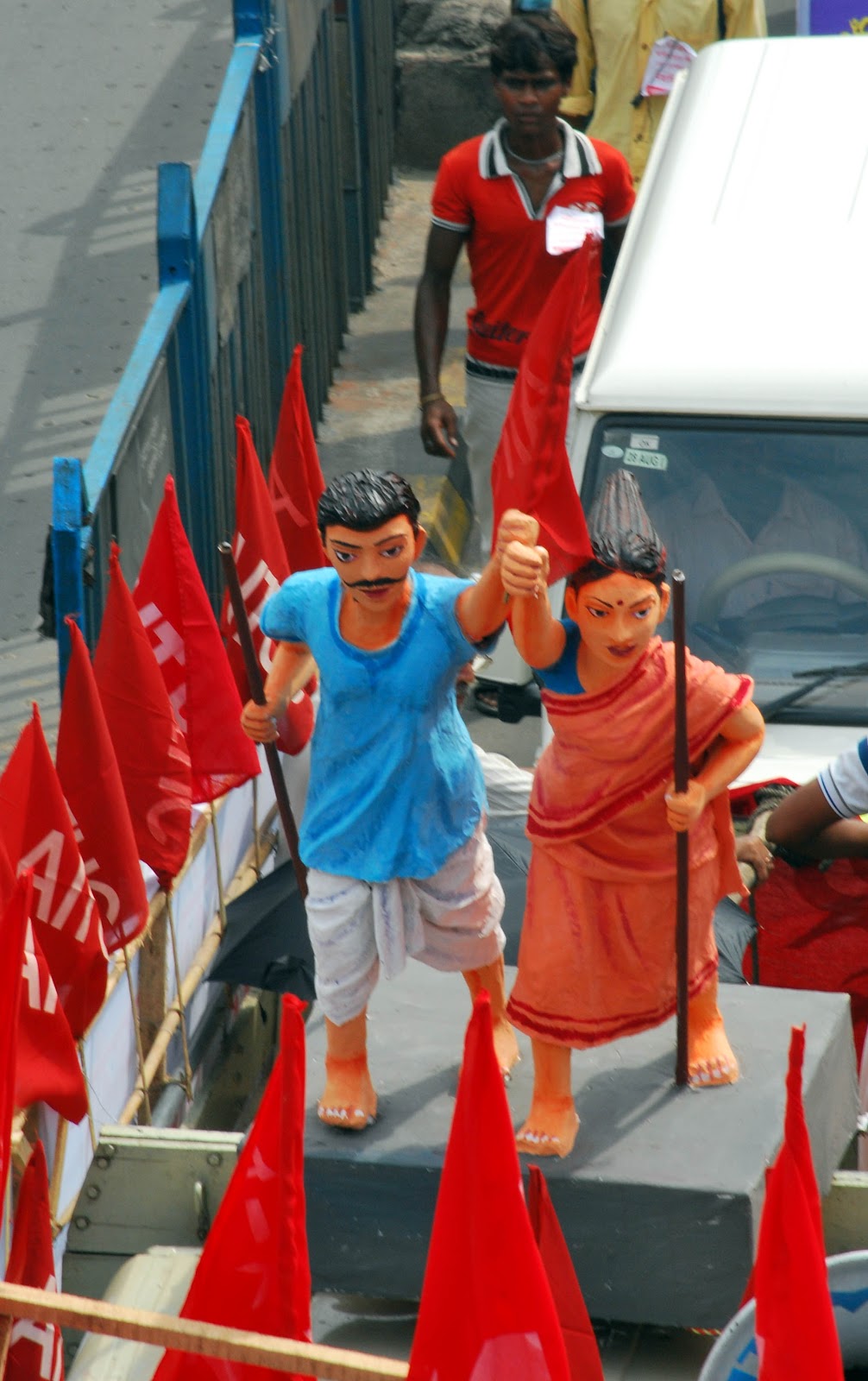
People, mostly from the districts of South Bengal, participated with full of enthusiasm to mark their protest against US aggression and to commemorate the Anti-Imperialist Day of 1st September. The state leaders of Left Front led the rally that started at 1 pm fromRani Rashmoni Road. It took more than two and half hours for the rally to reach Deshbandhu Park, even as the end part of the rally was still waiting at Rani Rashmoni Road. The rally was fully decorated with flags, festoons, and most importantly the mobile tableaus that remained the most attractive part of the rally.   It was exactly 4:30 pm when the last tableau along with people reachedDeshbandhu Park in the northern end of the city. People from all walks of life participated in the rally. Thousands marched with Red flags, once again registering the nature of protest in West Bengal.  

The rally raised voice against US imperialism’s thirst for natural resources in the world, its war crimes in Iraq, Afghanistan, Libya, its interference in South Asia, particularly in Indian economy through FDI in retail sector, privatisation of insurance sector, pension funds etc. The rally raised the voice for defending sovereignty and independent foreign policy of the country.

Addressing the huge gathering at the end of the rally, CPI(M) Polit Bureau member Buddhadeb Bhattacharjee gave a backdrop of USimperialism to correlate the magnitude of the contemporary imperialist aggression in the world. Having mentioned the Atom Bomb attack over Hiroshima and Nagasaki as a birth of today’s US-led imperialism, Bhattacharjee explained the contours of imperialist aggression from Vietnam to present day Iraq. Now the danger of imperialism comes in a different direction when US and allied countries target China and try to set base in India. We won’t tolerate US base in India to blockade India and would launch bigger protests, he said.

Bhattacharjee said that India is trying to set up a strategic partnership or alliance with USA. “What strategic alliance is this? We will protest against any such alliance. US secretary of state Hillary Clinton had made her visit to West Bengal. It was unprecedented for her to visit Writers’ Buildings?  Why did she go there”, he questioned. The state government has also expressed its inclination to invite US president for the youth festival in the state. Bhattacharjee warned of strong resistance if any such eventuality took place.

Left Front chairman Biman Basu while congratulating the people for making the rally a great success said that US corporates are using our markets to meet their internal crisis. “They are trying to control our economy. So we must keep our struggle on against such imperialist aggression. If any of US official comes to commemorate the 150th birth anniversary of Swami Vivekananda on 12th January next year, the state will definitely revolt”, asserted Basu.

Siliguri too witnessed an impressive anti-imperialist rally on the day where at least 10,000 people participated.  

Rallies Planned against Imperialism on September 1


KOLKATA: 1ST September, 1939 was the day when fascist Germany led by Adolph Hitler invaded Poland to start the world's deadliest war till date against humanity. Since then the destruction of life and property continued for five long years - throwing the entire world into war and anarchy. To remind ourselves of the futility and destruction of war, people of the world have been observing 1st September as the World Peace and Anti War Day. West Bengal has a long tradition of observing the World Peace Day. This year is going to be no exception. The Left Front Committee of West Bengal has convened a rally in Kolkata and Siliguri to observe this day.

The non-aligned foreign policy of our country has seemed to be derailed. India has voted for US proposal of strengthening sanctions on Syria in Security Council when even Pakistan dared to abstain. Before that India supported US-British proposal against Iran in International Atomic Energy Agency (IAEA).  India-US military understanding has also been in progress. Despite protests from different corners of the country, the government went ahead with Defense deal, joint army exercises, assistance in military operations etc. India has also endorsed CTBT and civil nuclear treaty. Imperialism now has a direct impact on the life of every Indian citizen and the UPA government in pushing the country to be a junior partner and collaborator of US imperialism. The recent WikiLeaks exposes have also thrown light on how the Indian government has bent to the whims of US imperialism. The pipeline issue with Tehran went under wraps after indirect intervention from US.

The military aspirations of imperialism have been on violent display during recent period. Unresisted, the imperialism would bring the humanity to the verge of destruction once again. There is therefore urgent need to bolster up the flag of humanity and raise our voice in favor of peace and against war. The World Peace and Anti War Day, therefore, is still relevant, stressed the Left Front leaders.

The Left Front’s demands on World Peace and Anti War Day:
       No war but restoration of peace. Imperialism be demolished. US imperialism go back.
       Raise voice against imperialist aggression in several countries
       US -Israel must go back from Palestine
       US imperialism must go back from the Arab world
       US interference in South Asia has to be stopped
       US warships must be removed from the Indian Ocean and Bay of Bengal
       UPA government has to answer for their soft stand against blatant US pressure
       Foil imperialist conspiracies against India. Stop US interference in India
       Resist compromise of sovereignty to the imperialism
       Set aside India’s pro-imperialism foreign policy
       Unite against domination of imperialism in Asia Pacific region
       Set aside the civil nuclear treaty with US
       Gas supply treaty with Iran should not be amended due to US pressure
       Stop US interference in Syria
       Israel has to do away with the illegal capture of Palestine
       Stop US-Israel barbaric activities on Arab people
       India has to stand by Iran against US- Israel conspiracy